

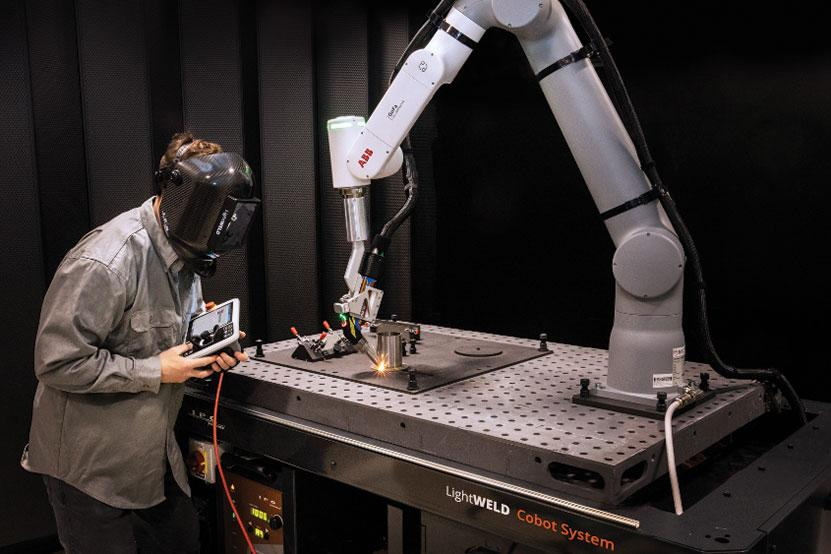
Robot laser welding machine is changing the way manufacturers join metal parts. It combines industrial robots with powerful laser technology to create fast, accurate, and consistent welds. This process is now widely used in automotive, aerospace, electronics, medical equipment, and other manufacturing industries.
Unlike traditional welding methods, Robot laser welding machine can produce precise welds with less heat and reduced material distortion. The robot controls the movement, while the laser delivers focused energy to the exact welding area. This combination helps companies improve production speed, reduce waste, and maintain consistent quality.
As industries move toward automation and smart manufacturing, Robot laser welding machine has become an important technology. It allows manufacturers to handle complex welding tasks that may be difficult or time-consuming for manual workers. This article explains how Robot laser welding machine works, its benefits, applications, challenges, and future potential.
What Is Robotic Laser Welding?
Robot laser welding machine is an automated welding process that uses a programmable industrial robot and a laser beam to join materials. The robot moves the laser welding head along a planned path, while the laser generates concentrated heat to melt and join the material.
The laser beam focuses energy on a very small area. This allows the welding process to create narrow and deep welds. Because the heat is concentrated, surrounding areas receive less thermal energy compared with many traditional welding methods.
A typical system includes an industrial robot, laser source, welding head, control software, safety equipment, and monitoring systems. The robot can perform the same movement repeatedly with a high level of accuracy.
This makes Robot laser welding machine especially useful for large-scale manufacturing. Once the system is properly programmed, it can perform repetitive welding operations with consistent results.
How Does Robot laser welding machine Work?
The Robot laser welding machine process begins with the preparation of the workpieces. The materials must be correctly positioned and held in place. The robot then follows a programmed welding path.
The laser source produces a powerful beam of light. This beam travels through an optical system and reaches the welding head. The focused laser creates enough heat to melt the surfaces of the materials.
As the molten material cools, it forms a solid joint. Depending on the application, filler material may also be used. Some processes use additional shielding gas to protect the molten metal from unwanted reactions with the surrounding air.
Modern robotic systems may also include sensors and cameras. These tools can monitor the weld seam and help the robot adjust its position when needed.
Main Components of a Robot laser welding machine System
A Robot laser welding machine system includes several important components. Each part plays a role in producing accurate and reliable welds.
The industrial robot provides movement and positioning. Robots with multiple axes can reach difficult angles and follow complex welding paths. This flexibility is one of the main reasons automated laser welding is valuable in modern factories.
The laser source creates the energy needed for welding. Different laser technologies may be selected based on the material, thickness, speed, and application requirements.
The laser processing head focuses and directs the beam toward the workpiece. Additional components can include wire feeders, gas delivery systems, sensors, fixtures, and quality monitoring equipment.
Control software connects the entire system. Operators can program welding paths, adjust parameters, monitor performance, and manage production processes.
Benefits of Robotic Laser Welding
One major advantage of Robot laser welding machine is precision. Robots can repeatedly follow the same programmed path with a high level of consistency. This helps manufacturers maintain stable weld quality across large production runs.
Speed is another important benefit. Laser welding can be faster than some conventional welding methods, especially when producing thin or medium-thickness components. Faster production can help companies increase output.
Robot laser welding machine can also reduce heat distortion. Because the laser concentrates energy in a small area, less heat may spread through the surrounding material. This is useful for components that require accurate dimensions.
Automation can also improve workplace safety. Workers can supervise the system instead of performing every welding operation manually. However, proper laser safety systems and training are still essential.
High Precision and Better Weld Quality
Manufacturers often choose Robot laser welding machine because of its ability to produce clean and precise joints. The focused laser beam allows better control over the welding area.
Consistent robot movement also reduces variations caused by manual welding techniques. Every production cycle can follow the same programmed instructions.
High-quality welding is especially important in industries where small defects can create serious problems. Automotive components, aerospace parts, batteries, and medical devices may require strict quality standards.
Advanced monitoring technology can further improve quality control. Sensors can detect changes in seam position, temperature, penetration, or other important welding conditions.
These systems can help manufacturers identify potential problems earlier and reduce the number of defective products.
Common Applications of Robotic Laser Welding
The automotive industry is one of the largest users of robotic laser welding. Manufacturers use automated laser systems to join body panels, structural parts, battery components, and other metal assemblies.
In aerospace manufacturing, precision is extremely important. Robot laser welding machine can support the production of lightweight and complex components while helping control heat input.
Electronics manufacturers also use laser-based processes for small and delicate parts. The focused energy allows work to be performed in areas where traditional welding equipment may be too large or difficult to control.
Medical equipment production is another important application. Certain medical devices require clean, accurate, and repeatable joining processes.
Robot laser welding machine can also be used in general metal fabrication, energy production, shipbuilding, and industrial equipment manufacturing.
Robot laser welding machine vs Traditional Welding
Traditional welding methods such as MIG, TIG, and arc welding remain useful for many applications. However, Robot laser welding machine offers different advantages.
Laser welding can provide a smaller heat-affected zone. This may reduce distortion and decrease the need for additional finishing work.
Robotic systems also provide greater repeatability. A properly programmed robot can perform the same task continuously without the natural variation associated with manual operations.
However, traditional welding may be more practical for certain materials, thicker components, or lower-volume projects. The best welding method depends on production requirements.
The initial cost of Robot laser welding machine equipment can also be higher. Companies must consider equipment, installation, programming, maintenance, safety systems, and employee training.
Industries That Use Robotic Laser Welding
Many industries are investing in Robot laser welding machine as automation becomes more important. The automotive sector uses it for high-volume production and precise component assembly.
Aerospace companies use advanced welding systems for complex and lightweight components. High accuracy and controlled heat input can be valuable for specialized materials.
The energy industry may use automated welding for selected equipment and components. Manufacturers producing electrical systems and battery technology also benefit from precise laser processes.
Consumer product manufacturers can use Robot laser welding machine when they need consistent results across thousands or millions of units.
As robotic technology becomes more flexible, smaller manufacturers may also find new opportunities to use automated welding systems.
Challenges and Limitations
Despite its advantages, Robot laser welding machine also has challenges. The initial investment can be significant. A complete system may require robots, laser equipment, safety enclosures, fixtures, software, and monitoring tools.
Programming is another important factor. Complex components may require skilled engineers or technicians to create accurate robot paths and optimize welding parameters.
Material preparation can also affect results. Incorrect alignment, contamination, or inconsistent gaps between components may reduce weld quality.
Maintenance is necessary to keep the system operating correctly. Optical components, robotic equipment, cooling systems, and safety devices should be inspected regularly.
Companies should carefully analyze their production needs before investing. High-volume or precision manufacturing environments may receive greater benefits from automation.
The Role of Automation and Smart Manufacturing
Robot laser welding machine fits naturally into modern smart factories. Automated systems can communicate with production software, sensors, inspection equipment, and data management platforms.
Real-time monitoring can help manufacturers track production performance. Data from the welding process may be used to identify trends and improve quality.
Artificial intelligence and machine learning may also play a larger role in future welding systems. Advanced software could help detect defects, optimize parameters, and improve predictive maintenance.
Connected manufacturing systems may allow engineers to monitor multiple robotic cells from a central location. This can improve efficiency and support better production planning.
Automation does not completely remove the need for skilled workers. Instead, the role of workers may shift toward programming, maintenance, inspection, and process optimization.
How to Choose the Right Robot laser welding machine System
Choosing a Robot laser welding machine system requires careful planning. Manufacturers should first evaluate the materials they need to join.
Material type, thickness, joint design, production volume, and required welding speed can all affect the final system design.
The size and complexity of the workpiece are also important. Some applications require robots with a larger working range or additional axes.
Quality requirements should also be considered. Industries with strict standards may need advanced monitoring and inspection technology.
Companies should also evaluate the availability of technical support and training. A reliable supplier can help with installation, programming, maintenance, and future upgrades.
Future Trends in Robotic Laser Welding
The future of Robot laser welding machine looks promising. Manufacturing companies continue to search for faster, more accurate, and more efficient production methods.
Collaborative technologies, advanced sensors, artificial intelligence, and improved laser systems may make automated welding even more flexible.
Future robots may become easier to program and faster to adapt to new products. This could make Robot laser welding machine more accessible to small and medium-sized manufacturers.
Battery manufacturing, electric vehicles, renewable energy, and advanced electronics may also create new demand for precise automated welding.
As technology continues to develop, Robot laser welding machine is likely to become an even more important part of modern industrial production.
Frequently Asked Questions About Robotic Laser Welding
What is Robot laser welding machine used for?
Robot laser welding machine is used to join metal components with high speed and precision. Common applications include automotive manufacturing, aerospace, electronics, medical devices, and industrial equipment.
Is Robot laser welding machine better than traditional welding?
It depends on the application. Robot laser welding machine offers excellent precision, repeatability, and reduced heat input. Traditional welding may still be more suitable for certain materials, projects, or budgets.
Can Robot laser welding machine improve production speed?
Yes. Automated laser systems can perform repetitive welding tasks quickly and consistently. This can help manufacturers increase production efficiency.
Is Robot laser welding machine expensive?
The initial investment can be high because the system may require robots, laser equipment, safety systems, software, and installation. However, high-volume production can provide long-term efficiency benefits.
What materials can be laser welded?
Laser welding can be used with many metals, including different types of steel, stainless steel, aluminum, and certain specialized alloys. Material compatibility depends on the specific application and system.
Does Robot laser welding machine require skilled workers?
Yes. Skilled workers are needed for programming, system operation, maintenance, quality control, and process optimization. Automation changes the role of workers rather than completely eliminating the need for expertise.
Conclusion
Robot laser welding machine is a powerful manufacturing technology that combines automation, precision, and speed. By using programmable robots and focused laser energy, manufacturers can create consistent welds while improving production efficiency.
The technology offers major benefits, including high accuracy, repeatability, reduced heat distortion, and better process control. It is already widely used in industries such as automotive, aerospace, electronics, and medical manufacturing.
Although Robot laser welding machine requires a significant investment and technical expertise, its long-term advantages can make it valuable for companies with demanding production requirements. As automation, artificial intelligence, and smart manufacturing continue to grow, Robot laser welding machine will likely play an even bigger role in the future of industrial production.
