

The digital age has fundamentally transformed how we consume narratives, moving from traditional print to the vertical-scrolling world of webtoons. Originating in South Korea, this medium has exploded into a global phenomenon, captivating millions of undergraduate students worldwide. Beyond the vibrant art and engaging plotlines, webtoons offer a rich field for academic inquiry, spanning sociology, digital media, and even cognitive science. For a student, analyzing these digital comics provides a unique opportunity to explore how technology reshapes human storytelling and cultural exchange.
Navigating the transition from leisure reading to academic analysis can be daunting, especially when your course load is at its peak. When the pressure of multiple deadlines starts to mount, many students find that seeking professional support is a smart way to manage their time effectively. Choosing to do my assignment for me cheap allows you to maintain your focus on complex research while ensuring your grades remain high. By delegating some of the heavy lifting, you can dive deeper into the fascinating intersection of pop culture and academic theory, ensuring that your work meets the high standards required for top-tier university submissions.
The Evolution of the Vertical Scroll: A Cultural Shift
The shift from horizontal page-turning to vertical scrolling is not just a technical change; it is a fundamental shift in how we perceive time and space within a story. This “infinite canvas” allows creators to manipulate the reader’s pace, using white space to build tension or long, continuous backgrounds to simulate a journey. For researchers, this format offers a goldmine of data on user interface (UI) design and its psychological impact on reader engagement and retention. Unlike traditional comics, the scroll mimics the way we consume information on social media, making it instinctively accessible to the digital-native generation.
Webtoons have also democratized the publishing industry. Unlike traditional manga or Western comics, which often require a gatekeeper or a major publishing house, webtoons allow independent artists to reach a global audience directly. This has led to a more diverse range of stories, reflecting a variety of cultural backgrounds, gender identities, and social issues that were previously underrepresented in mainstream media. The “Comment” section further bridges the gap between creator and consumer, allowing for a real-time cultural dialogue that shapes the story as it evolves.
Exploring the Biological and Psychological Impact of Digital Art
Interestingly, the science behind how we process visual information in webtoons is becoming a popular area of study. The high-contrast colors and specific panel arrangements are designed to keep the brain engaged, often leading to what psychologists call a “flow state.” This state of deep immersion is what makes the medium so addictive. Understanding the neurological response to these visual stimuli can provide insights into digital consumption habits, visual literacy, and even educational psychology. Researchers are looking into how the brain switches between reading text and interpreting art, and how this affects memory retention.
| Research Domain | Focus Area | Potential Academic Outcome |
| Media Studies | Global distribution of Manhwa | Understanding Hallyu (Korean Wave) 2.0 |
| Psychology | Scrolling behavior & dopamine | Insights into digital consumption habits |
| Sociology | Representation in webtoons | Analysis of modern social identity |
| Computer Science | AI-assisted coloring tools | Study of human-AI collaboration in art |
| Economics | Freemium monetization models | Analysis of digital micro-transactions |
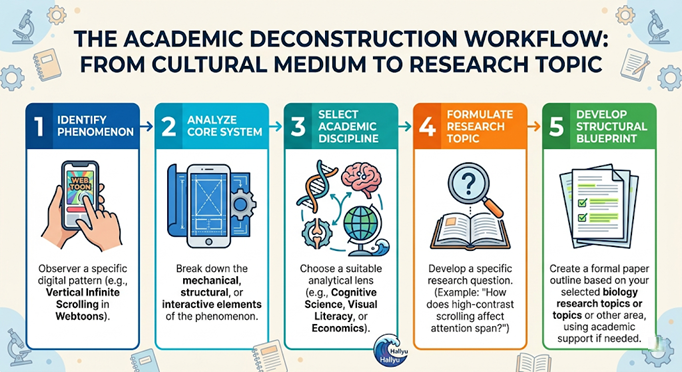
For students pursuing STEM or social science degrees, these intersections are vital for creating “Information Gain” in their essays. If you are looking for more traditional scientific inspiration to balance your pop-culture research, exploring a list of biology research topics through MyAssignmentHelp can give you the structural blueprint needed to craft a high-distinction paper. Their experts help bridge the gap between complex scientific theories and clear, academic writing, ensuring your research is both authoritative and easy to follow, which is essential for ranking well in modern academic databases.
The Economic Engine of the Webtoon Industry
The business model of webtoons is equally fascinating. The “freemium” model—where most content is free but users pay for “fast-pass” early access—has revolutionized digital monetization. This model relies heavily on data analytics to track user behavior, genre popularity, and churn rates. Business and marketing students can analyze these trends to understand how digital platforms build brand loyalty in a highly competitive attention economy. It is a masterclass in psychological pricing and community building.
Furthermore, the “one-source, multi-use” (OSMU) strategy has seen webtoons adapted into hit series, movies, and merchandise. This cross-media synergy provides a perfect case study for intellectual property law and global marketing strategies. It demonstrates how a single creative spark can ignite a multi-million dollar franchise across different platforms and cultures. The rise of “webtoon-to-drama” adaptations on streaming services has created a feedback loop where the success of a show drives new readers back to the original digital source.
Ethical Considerations in Digital Content Creation
As with any digital industry, the rise of webtoons brings forth ethical questions regarding labor and copyright. Many creators face grueling weekly schedules to keep up with audience demand, leading to discussions about burnout and the need for better industry standards. For a law or ethics student, this presents an opportunity to discuss the protection of creative workers in the gig economy. The democratization of the platform also means that moderation is a constant battle, as platforms must balance free expression with the protection of younger readers from mature themes.
Bridging Entertainment and Education
As webtoons continue to grow, their role in education is also expanding. Educators are beginning to use the format to explain complex historical events, scientific processes, or literary themes. The visual-heavy nature of the medium makes it particularly effective for ESL (English as a Second Language) learners and students who struggle with dense, text-only textbooks. By simplifying complex information into digestible, visual panels, webtoons make learning more inclusive and engaging.
For an undergraduate student, the takeaway is clear: the things you enjoy in your downtime are often the most fertile ground for academic exploration. Whether you are analyzing the brushstrokes of a digital artist or the data behind a platform’s growth, you are engaging in high-level critical thinking. By approaching these topics with a scientific lens, you can produce work that is not only personally interesting but also academically rigorous.
The Future of Digital Storytelling
Looking forward, the integration of AR (Augmented Reality) and AI (Artificial Intelligence) in webtoons is the next frontier. AI is already being used to assist with coloring and background rendering, allowing creators to produce high-quality work faster. However, this also sparks debates about the soul of art and whether technology can ever replace the human touch in storytelling. For tech-focused students, the evolution of the webtoon platform is a living laboratory for the future of the internet itself—moving toward a more interactive, visual, and globally connected experience.
Final Thoughts for the Academic Researcher
When writing about these topics, it is crucial to maintain a global tone. While the medium started in Asia, its impact is felt from New York to London and Sydney. Using diverse examples from different genres—such as fantasy, slice-of-life, and thriller—will make your research more comprehensive. Always ensure that your arguments are backed by data and that your formatting is clean, using subheadings and lists to keep the reader engaged. This approach ensures your work is recognized as a valuable contribution to the field rather than just a fan piece.
Frequently Asked Questions (FAQ)
1. Why are webtoons a good topic for a research paper?
Ans: Webtoons represent a modern intersection of technology, art, and global business. They offer fresh data for studies in media, psychology, and sociology that haven’t been over-exhausted in traditional academia.
2. How can I find credible sources for a webtoon-related essay?
Ans: Look for peer-reviewed journals on digital media, reports from industry analysts, and interviews with creators. Databases like JSTOR or Google Scholar are great starting points.
3. What is the “Information Gain” in writing about digital comics?
Ans: Information gain involves providing new perspectives—such as the psychological impact of vertical scrolling or the specific economic impact of the “fast-pass” system—rather than just summarizing what a webtoon is.
4. How do I balance my hobby with my academic responsibilities?
Ans: Time management is key. Use your interests as a reward for finishing a study session, or consider using academic support services when your workload becomes unmanageable to ensure you don’t fall behind on core subjects.
5. Can I use webtoons to learn about other cultures?
Ans: Absolutely. Many webtoons are deeply rooted in the cultural nuances of their creators, offering readers a window into the social norms, folklore, and daily life of people from different parts of the world.
About The Author
I am Cooper Robinson, a Senior Academic Consultant and Content Strategist at MyAssignmentHelp. With a background in educational psychology and a passion for digital media trends, I specialize in helping undergraduate students bridge the gap between contemporary culture and rigorous academic research.
