

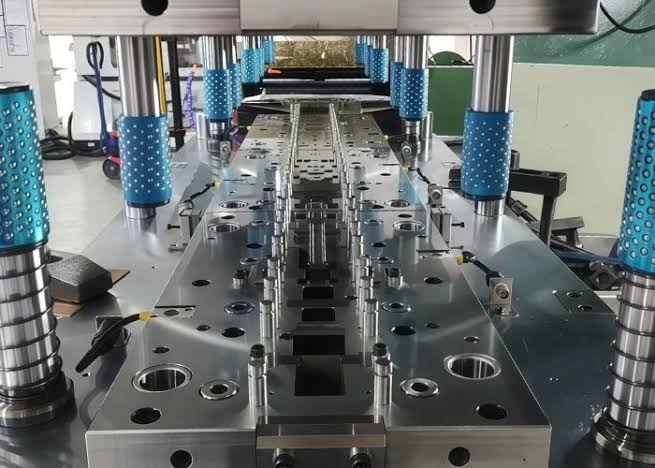
Carbon steel stamping is a reliable metalworking method used to manufacture components from carbon steel sheets, strips, and coils. The technique uses specialized dies and powerful presses to cut, shape, or form metal into precise configurations. It is widely used because manufacturers can produce consistent parts while controlling production time and material costs.
From small brackets and clips to larger industrial components, carbon steel stamping can support many product designs. The process can also be adapted for low-volume prototypes or high-volume production. Choosing the right steel grade, tooling strategy, and stamping technique is essential for achieving reliable results.
What Makes Carbon Steel Stamping Different?
Carbon steel stamping differs from ordinary metal cutting because it can combine several forming operations. Instead of simply removing material, the process can change the geometry of a steel sheet while maintaining its overall strength.
A stamping press delivers force through a punch and die. The die controls the shape while the punch pushes the material into the required position. Depending on the operation, the steel may be cut, bent, stretched, compressed, or drawn.
This flexibility allows manufacturers to create components that would be difficult to produce using simple cutting methods.
How Carbon Steel Grades Affect Stamping
The choice of carbon steel has a direct effect on how successfully a component can be stamped. Different grades have different levels of strength, hardness, ductility, and formability.
Low-carbon steel is often selected for parts that require extensive bending or forming. Its higher ductility makes it easier to shape.
Medium-carbon steel offers increased strength but may require more careful forming conditions. Higher-carbon materials can provide additional hardness and wear resistance, but their reduced formability may make complex stamping more challenging.
Engineers should consider the finished component’s function before choosing a grade. The best material is not always the strongest material. It should provide the right balance between performance and manufacturability.
Important Stamping Equipment
The stamping press is one of the most important pieces of equipment in the production process. Mechanical presses are commonly used for fast, repetitive operations. Hydraulic presses can provide controlled force and are useful for certain forming applications.
Automatic feeding systems can move steel strips into the press at precise intervals. These systems are particularly useful for high-volume production.
Other equipment may include coil handling systems, straighteners, inspection machines, deburring equipment, and finishing systems.
The equipment combination should match the component design and production requirements.
Common Precision Stamping Techniques
Several techniques can be used during carbon steel stamping. Blanking removes a desired shape from a sheet, while punching creates holes or openings.
Bending changes the angle or direction of a section. Forming creates curves or other three-dimensional features.
Drawing is used when a flat piece must become a deeper shape. Coining can produce precise details by applying high pressure to selected areas.
Manufacturers may combine multiple techniques to complete a component efficiently. The selected process depends on geometry, thickness, tolerances, and production quantity.
Benefits of Using Carbon Steel
Carbon steel offers several advantages for stamped components. One of the most important is its combination of strength and affordability.
The material is widely available in many grades and thicknesses. This makes it easier for manufacturers to source suitable material for different projects.
Carbon steel can also provide good durability in demanding applications. When properly designed and finished, stamped components can perform reliably for extended periods.
Other advantages include:
- Cost-effective material options
- Good structural strength
- Flexible material grades
- High-volume production capability
- Excellent repeatability
- Compatibility with automation
- Wide range of applications
- Recyclability of steel scrap
These characteristics make carbon steel stamping a practical choice for many manufacturers.
Designing Parts for Better Stamping
Good component design can make the stamping process more efficient. Engineers should consider material thickness, bend locations, hole sizes, corner radii, and tolerances during the design stage.
Sharp corners may create unnecessary stress concentrations. Suitable radii can improve material flow and reduce the risk of cracking.
Holes should also be positioned carefully. If they are too close to an edge, the material may deform during production.
Designers should work with stamping engineers before finalizing a component. Early collaboration can identify potential manufacturing problems and reduce expensive tooling changes.
Carbon Steel Stamping for Different Industries
Carbon steel stamping has applications across many sectors.
The automotive industry uses stamped components for brackets, supports, reinforcement pieces, mounting hardware, and other parts.
Construction companies and equipment manufacturers use stamped steel for connectors, clips, brackets, and structural hardware.
Appliance manufacturers can use stamped components for internal supports, panels, mounting pieces, and mechanical parts.
Industrial machinery also depends on stamped carbon steel components for covers, brackets, guards, supports, and assemblies.
Other applications can be found in electrical equipment, agricultural machinery, HVAC systems, transportation products, and consumer goods.
The Role of Tooling and Die Design
Tooling determines much of the quality achieved during carbon steel stamping. A die must be designed around the material, part geometry, production speed, and required tolerances.
Poor tooling can lead to excessive burrs, uneven edges, distortion, cracking, or dimensional problems.
Good die design can improve production efficiency and extend tooling life. Engineers may use simulations and computer-aided design tools to predict material movement before manufacturing the die.
Regular maintenance is also important. Cleaning, lubrication, inspection, and timely replacement of worn components can help maintain consistent production.
Quality Testing for Stamped Components
Quality inspection ensures that finished parts meet their required specifications. Manufacturers may check dimensions using gauges, measuring equipment, or automated inspection systems.
Visual inspection can identify scratches, cracks, burrs, wrinkles, and other surface defects.
Functional testing may also be required when the component has a specific mechanical purpose. For example, brackets may need to withstand certain loads.
Quality control should not be limited to the finished part. Monitoring material quality, tooling condition, press settings, and production parameters can help prevent defects before they occur.
Surface Protection and Finishing
Although carbon steel provides excellent mechanical performance, untreated steel can be susceptible to corrosion. Many stamped components therefore receive protective finishing.
Painting and powder coating can provide both protection and an attractive appearance. Plating can add a protective surface layer and may improve specific performance characteristics.
Galvanizing is another option for applications that require increased corrosion resistance.
The finishing method should be selected based on the environment and expected service life of the component.
Production Volume and Stamping Selection
Production quantity is an important factor when selecting a stamping method. Low-volume projects may use simpler tooling to reduce initial investment.
For large orders, progressive stamping can provide significant efficiency. A continuous strip passes through several stations, with each station completing part of the manufacturing process.
Transfer stamping can be appropriate for certain larger or more complex components. Choosing the correct method can reduce production time and improve the overall cost per part.
Tips for Selecting a Stamping Supplier
Businesses should evaluate several factors before selecting a carbon steel stamping supplier. Experience is important, especially when components require tight tolerances or complex forming.
A capable supplier should have appropriate presses, tooling resources, inspection equipment, and experienced technical staff.
It is also helpful to review production capacity and quality procedures. Suppliers should be able to clearly discuss material specifications, tooling costs, production schedules, finishing requirements, and packaging.
Strong communication throughout the project can help prevent misunderstandings and production delays.
Conclusion
Carbon steel stamping remains an important manufacturing solution because it combines efficient production with reliable material performance. The process can create accurate components for automotive, construction, machinery, appliances, electronics, and numerous other industries.
Success depends on several factors, including material selection, component design, tooling quality, press capabilities, inspection procedures, and surface protection. When these elements are properly managed, manufacturers can produce durable parts with consistent dimensions and competitive production costs.
As manufacturing technology continues to develop, carbon steel stamping is likely to remain a valuable process for businesses that require scalable and dependable metal components.
